Saturday, May 16, 2020

More research, but real stuff too. Long post.

As I alluded to yesterday with the update, the monster generator isn't as bad as originally thought and my testing indicated.  I watched a few review videos, such as https://www.youtube.com/watch?v=VsSmcGh92Rw and while right next to it is louder than a normal conversation, it isn't by much and is easily talked over.  This is in line with Matt's coworker's experiences.

I also came across some load test videos (like https://www.youtube.com/watch?v=nwQZCxXPWrw) and realized that when I am using it in the camper, it will likely never throttle up.  It doesn't throttle up until you hit ~3.6kW, which I likely won't use.

After chatting with Dad a bit, I don't think I will try the water trick to make it quieter except as a last resort; I don't like changing how the engine works to make it quieter.  Putting the exhaust in water would slightly change the compression from the engine which could in theory shorten the lifespan of my $4500 monster generator.

I was having some trouble falling asleep last night, so I decided to go and create an electrical conceptual diagram, since it is complicated with multiple sources.  I have a concept that I think will work, but I would have to manually set up the breakers every time I plugged in the generator to turn off the power from the battery and turn on power to the battery so it recharges from the generator.  I don't know how this is all automatically handled in commercial campers, though I guess I could design a board that detects available sources and triggers the proper relays to let power pass correctly.  I poked Uncle to see if he knows how his works and how far off base I am.


I started to do a little more 12V research, looking at batteries and the like.  I would still like to get a lithium battery, but at the smaller capacities, sealed lead acid snuck in despite the weight and is massively cheaper, so I poked Uncle to see how big his battery is.  Mine will need to be bigger, since I am not running a propane fridge (the options for that kind of stink), and it will have the microwave to run (yes, I consider a microwave part of the critical stuff box), and so on.  The whole spreadsheet comparing the different products I have looked at (batteries, panels, solar systems, generators, and so on) is now posted on my Google Drive since Microsoft did a helpful update on my work computer that means I can no longer click links in Excel.  It is available here: https://drive.google.com/file/d/16g0W-_9pEH2vaUiGeYPaBuW3A21ksxqL/view?usp=sharing

I looked at some 12V solar panels, but it looked like the comparison I did (sadly not documented above) when I bought the Renogy kit for testing was pretty much what there is.

Today started out kind of icky, everything was still drenched from the storms last night, so I started with some laziness.  Dad sent me a picture of the dump truck brake drums, and I think if I hit it with a wire wheel and paint it, they actually would look pretty nice.  I also installed the new SSD in my laptop, since its old one is one of the ones I was going to bring down for the new core for Jess' computer.  I also started getting things together for the KY trip next week, I will have a fuller truck this time than normal. 

Uncle Dennis gave me a call, since I had been asking him questions about how his camper solved certain problems.  One of the things we discussed was that his camper did the electric as basic as you can get.  I actually much prefer this, even if it means going with a lot of 12V stuff.


I also asked him about his battery size, and he said it was just a small one from the camper store.  His two small deep cycle marine batteries last him about a week off-grid, though he goes extremely minimalist when he is using it on battery (no more than 1 light on, not even microwave to heat his coffee). 

If I wanted to use that design which is extremely simple, I would have to change the kitchenette design which currently makes use of a standard 4.4 cubic foot dorm fridge, which requires 110v.  I chose that because I wasn't pleased with the smaller sized offerings for propane + electric fridges, but I didn't look too hard.  Though I could use a small passive inverter at the kitchenette that pulls in 12V and just use a 12V microwave and keep the design and the fridge that I like.  It means beefy wires (700W + ~200W = 900W = 75A @ 12V) but most of the 12V microwaves come with what look like 4 or 2 gauge wires which I wouldn't mind dual-purposing for the fridge.  Or I could use a normal microwave and get a bigger inverter like this one: https://www.eastwood.com/1000w-pure-sine-wave-power-inverter-w-remote.html There are many options, I just have to watch the wattage of the microwave and the starting wattage of the fridge.  The GE model 4.4 cubic foot fridge with freezer was ~85W running with an 180W inrush, so that would limit me to a 800W microwave (small but fine for a camper).  Either way, there are lots of options. 

Uncle had another entertaining thought too: why not just rent one, try it and reverse engineer it?  I can rent it for a week in the summer, take it out to an RV park, learn how it works, how to dump the tanks, and so on in a sheltered environment (perhaps at a place with a metered electric plug), and then maybe in the fall, rent it again and boondock with it (closer to my expected use case).  See if I like it, learn a bit, find gotcha's that I haven't even considered yet (like leveling it...).  The idea certainly has merit. 

After all that though, it turned out to be a really nice day today.  I started by finishing up some overdue cutting.  I got the skirting I was supposed to bring down cut in half.  Unfortunately it looks like part of it got damaged sitting outside the past couple years (look at the top right of the piece).


It needs a good pressure washing too.


I also got the boards cut for the last cabinet rack I am planning on building.  This one is bigger so it can hold boxes of ziplocks.


I also did the well overdue oil change on the car.  The new ramps suck, but they are all you can find these days.  I had debated building my own, and still might. 


I found out when I went dump the used oil back into the jug that my funnel has apparently cracked.  Cracked quite badly.


So I went and grabbed my only other funnel out of the kitchen.  Turns out it was cracked too, but it at least didn't leak everywhere.  It is nearly impossible to wash the oil out of though, so it is dead to me now. 


I also got the boards cut and painted for the south facing window.


After that I decided to transition to the table.  I got some beautiful cabinet grade boards from Tim (one of his perks for working for a furniture manufacturer).


I sketched up a quick design of what I want to do with them. 


I will have to find new hinges though.  My leftover piano hinge the holes are dangerously close to the edge since they were designed for a 1 by board, and this is 5/8 plywood.


I went to sand everything and thought it was a good time to pull out the air sander that I got from a coworker last year.  He won it at a raffle after I made him a step stool so he gave it to me.  It is a very high end orbital sander (costs over 200 bucks) so I made out good on it. Unfortunately though, I have never used it before.  The sandpaper I bought was plain, and this requires adhesive backed paper.  D'oh!


So I ended up sanding everything by hand with my trusty old block.  For over 2 hours.  Used every piece of sandpaper I had too, but everything is perfectly smooth now. Except for the piece I plumb forgot to cut.  I am out of sandpaper now though except for a few scraps I have in various places.


It was nice to get out and get some real work done, and a really nice day for it. 

Friday, May 15, 2020

Studies of sound.

Yesterday I also checked Northern for generators.  They do in fact have a few interesting models, including a contender for option 2, an inverter generator that is bigger and cheaper than the monster Honda.

My biggest concern with the generator in the back of the truck approach has been the sound.  While perusing the internet today, I saw someone who built an enclosure for their generator, conveniently a Honda EU2200is (the quietest generator I looked at, and a potential option 3 in the last post).  In their video, it was clearly a lot louder than the numbers lead you to believe.  If someone is parked next to me, I don't want them to complain or call the cops or anything if my generator is running.  So I ran some tests when I got home.

I tried to use the lawn tractor to do the measurements.  But it didn't feel like cooperating.  The battery was mostly dead.


Instead I used the pushmower.  It started up unhappily.


At 8 large steps away (roughly 24 feet) the mower turned in 56dB.  My curiosity peaked since the larger generators turned in that ballpark under low load, and the mid size generators turned in that range under full load.  So I approached the mower to see what it measured as I approached it.  Standing next to it turned in 65dB.  This raises the question: would I be willing to run my pushmower in the back of the truck while parked?


To satisfy my curiosity, I also checked my truck.  It measured a 48dB standing right next to the hood, and 40dB at ~25 feet (or on the other side of the car).  So everything I looked at would be significantly louder than the truck.  The smaller ones were 48-50dB at low consumption at ~25 feet.

Slightly confused by the numbers I was seeing, I also checked the example of talking being 60dB.  That example is very misleading.  It did measure 60 if the phone (my sensor) was 2 inches from my face and I talked directly into it.  Even at just arm's reach though, it drops to low to mid 50s.  A "typical" conversation is probably between 50 and 55dB if you are a participant.

After all the testing was complete, I decided to do something about the tractor since I probably ought to mow before I go down to KY for Memorial Weekend.  So I put the charger on it and jumped it.  It fired right up, and its numbers were comparable to the pushmower.  Interestingly, at ~25 feet, the different between low throttle and high throttle was only a few dB.  Sitting on the tractor, the difference is a lot larger though.  It is good to go though, I left the charger on it for a few hours.


I also researched a few ways to make a generator more quiet (that was how I came across the video with the EU2200i).  Some of them were pretty straightforward: put it in a sound absorbing box (make sure there is adequate ventilation!), put a car muffler on it (an interesting idea actually).  Some were odd, like run the exhaust into a bucket of water.  I looked at some of these ideas, and they do sell exhaust kits for the Honda EU3000is that bring out a pipe after the built-in muffler so you could in theory put an aftermarket muffler on it (or put it in water).  If that is as effective as the internet claims (they claim a solid 10-20dB drop), I am a little surprised that nobody makes a generator with a car muffler on it given that noise is the number 1 complaint with generators.  It might even be enough to make my current generator palatable.

One other option I briefly looked into was just putting a big-ass inverter on my truck.  I was willing to run a bunch of power off the alternator as an additional charging source for the solar setup, why not just idle the truck (plenty quiet enough) and run a big-ass inverter?  They make 2-2.5kW inverters I could hook directly into the battery circuit and mount under the hood.  It wouldn't be hard to carry extra gas (my truck has a wimpy and tiny tank on it).  Then I looked up the alternator, and the wuss of my truck extends beyond the tank.  The OEM rebuilt alternator for my truck is only a measly 130A.  That is sad.  The Buick had that on it.  The white truck with its V6 had that.  The Dodge had a 160A on it.  So drawing 2.5kW off the electrical system in the truck would be a very bad idea.  Just out of curiosity, I wonder what the idling noise rating of a semi is, since that is where I would be parked, in the trailer section. Perhaps later today I will investigate.

Since I wouldn't be willing to run a lawn mower in the bed of the truck because of noise, I am left with only options 1 and 3. Either way, if I did go with a generator (as opposed to just putting a monster alternator and gas tank in the truck), It looks like a soundproof box will be required.  They don't look complicated to build though.  Adding a car muffler would likely drastically reduce the portability of the generator, so that option is out.

UPDATE - Adding a muffler actually looks really easy on the 7000, and Matt knows people from his work that use them for testing and say they are quieter than the numbers suggest, so I might dig a little bit more into it before I axe it. 

Thursday, May 14, 2020

Generator. More text.

So Matt did a cost analysis of using a generator vs solar.  The graphs don't look pretty for solar.  If you just plot the cost of buying and running and maintaining a generator (3k cost, 3$ per gallon at the usage of a Honda EU3000i)  vs the cost of buying the solar, it looks really bad; 600 days of use to break even.  Even if I take two month long trips in it a year, that means 10 years for the solar to pay for itself.


Generators however don't normally last 10 years, so even factoring the cost of replacing the generator every 5000 hours, it still takes 400+ days to break even.


Even if that graph was updated to be the monster 7kW inverter generator from Honda that costs an arm and a leg, it still is cheaper until I have to replace it.


All those graphs assume that the solar equipment won't break as well.  The panels are usually good for 25 years, but the inverters and charger controllers and whatnot are not as reliable.  So the outlook on solar is not so good.  Kudos to Matt for remembering how to use Matlab and doing all the legwork for this.  While I think I am calling Time of Death for the solar idea, I do plan on leaving the roof clear and running extra wiring just in case I want to add it later when solar gets cheaper and more efficient.

Today I mostly just did research on generators.  Just to throw a couple of numbers around: The AC is around 1000W.  My toaster oven is 1400W.  Microwaves are around 1000W.  Add in some miscellaneous usage like the fridge and to run the camper I need around 3000W if I don't run the microwave and toaster oven at the same time.  To run my tiny home, I would need around 4500-5000W (my heat is 3500W by itself, though I could get by with a smaller portable heater for a short duration if need be).  5000W is likely sufficient even when I get the real house as long as I don't go with all electric appliances (which makes me twitch and convulse even just to write that).

There are a couple of approaches I can take (+ = pro, - = con, * = meh):

1. Go with a small generator, something like a 3kW model, get a companion for when I am at a campsite or as the home backup.
   + Plenty of power.  Even a single 3kW will run most of the camper while I am working.
   + The companion (total of 6KW) makes sure I can run everything all at once.
   + 3KW units are very quiet.
   + 6kW with companion (which is 5.2kW continuous) can adequately back up the tiny home.
   + Longest runtime per tank.
   + Units have value as small spot generators in a lean-to for lights and a power tool.
   - No 240V support.  That means no 240V heat pump and water pump as house backup.
        - Tiny home would require re-wiring/special handmade cable for use as home backup.
   - I have two generators to take out and start for home backup.
   - Surprisingly heavy for how small they are (131 lbs)
   - I have two generators to maintain.
   - Getting two of these and the parallel kit is expensive, upwards of 4k.
   * Unclear if this would be adequate for the real house (most likely yes though)
   * Leading candidate: Honda EU3000is
 
2. Go with a monster inverter generator, like the 7KW Honda, and it will be my generator for the camper and the house and for everything including the future full size home.
   + Plenty of power forevermore.
   + Future proof.  I can think of no scenario where this generator will be inadequate.
   + Can do everything.  Only option that gets me 240V
   + Long runtime, large tank.
   + Electric start.
   + Single generator, single cord for all applications.
   - Expensive. The only generator I saw in this range was the 7kW Honda priced at $4450.
   - Heavy (260lb), and hard to put in the back of the truck for trips.
   - Not as quiet as the smaller units, but still under 60dB.
   * Ludicrous overkill for running the camper.
   * Only candidate is the Honda EU7000is

3.  Get some specialized generation for the camper.  ie - 2 of the Champion 2kW cubes.
   + By far the cheapest option. 
        + Even including a larger third non-inverter generator this is still cheaper.
   + The quietest option if I spring the extra cash for the Honda over Champion.
   + One of these should run the AC (as long as I select the smallest split)
        * I would want to double check this.  It will literally run nothing else though.
   + Both will run the whole camper.
   + Small, light, easy to move around.
   + Units have value as small spot generators in a lean-to for lights and a power tool.
   - No 240V support.
        - Tiny home would require re-wiring for use as home backup.
   - Two generators (at least) to maintain.  Eventually 3.
   - Barely adequate to run a small space heater and the fridge in tiny home.
   - Unsuitable for whole home backup.  Would eventually buy another big generator.
        - This means more equipment to store and maintain.
   - Poor runtime, these typically only have a 1G tank on them.
   - The individual pieces don't have 30A plugs.  Would require two different backfeed circuits.
   - Isolating the AC circuit so that I could run only one complicates the electrical design.
   - They would require more complex wiring setups and more equipment when traveling.

Given that list of options, I like the first two the best.  I wish I could hear the 7kW monstrosity run, just to hear how loud it is.  I can see 53dB and 58dB and go that isn't a large difference, but decibels are funny in that they are logarithmic not linear, meaning it isn't 10% louder.  They say a normal conversation is 60dB for reference, but these numbers are also taken at different distances.  Champion for example states that they measure their noise level at 25 feet from the unit.

I have only gone through a couple of places, most notably Amazon and Home Depot, and I might go through Northern at some point, but I think I have a good feel for the market at this point.  If you want quiet, you pony up big bucks for Honda.  Champion and Briggs and Stratton have some offerings, but not a lot.  There is a lot more competition in the 2KW and under space, but that is the option I like the least.  It is a very expensive test as well, unless I want to buy the big one and then just return it if it is too loud.  The results of the generator research are below (I included some Predator models just for sanity checking). Click to enlarge


I also got tired of research (especially since my unlimited data has run out) and whipped up a quick design for a clothesline.  It was nice to pull out paper and pencil again.  It will also be nice to be able to run more than one load a day.  I plan on using PVC for it, 3" trunk and 1.5" branches.  Dad is looking at getting me some dump truck drums.  Looking at the bill of materials for it, it will be more expensive than a cheap fold up one, but unless I am overestimating the rigidity of PVC, should last a lot longer.  I still have a decision to make on the bottom branch.  The all PVC option adds a lot of cost for little benefit (I don't need beefy for hanging socks and underwear on it).  I am also debating whether I really need to put caps on everything.  They aren't expensive, maybe a dollar or two apiece, but 13 of them is a lot, and I am not sure they add any value.  I will probably have a drain hole near the concrete base anyways.  They would make it look nicer though.


Wednesday, May 13, 2020

Solar just won't cut it. Lots of text.

So I made a derp yesterday.  I didn't connect the grounds so the data it was gathering when I went home for lunch was all garbage. I got it fixed, and it was reading reasonably normal.  I don't like the precision of the new meter, but it seemed to be reasonably close to accurate.


I also ran the wire through the current loop sensor backwards resulting in the negative current.  Oops.


As a result, I made new harnesses to properly set this up in the afternoon.


When I got home though, I curiously didn't see what I expected to see.  Not sure what to make of it.


I also did some solar math (here begins the wall of text...).  The short version is that solar alone cannot safely make the trip unless I go solar crazy, supplement the solar, or plan the trip such that I never go more than 2 days without stopping at a campsite.  While all these are doable, they are rather unfortunate.  I need either supplemental charging or forced campsite visits to recharge the battery if I get a few consecutive cloudy days.

I consume 5.5kWh a day, and the battery I am using is 7.5kWh with an 80% depth of discharge, which means I have 6kWh usable.  I could easily double the battery, but that adds another 5k cost and another 200 lbs.

With the 375W panels I can expect each panel to produce 300Wh a day when it is cloudy, taking into account the 20% loss for not being angled and the possible 75% loss on a cloudy day.  If I just roll with 4 of them, that gives me 1.2kWh a day, that means the battery lasts around 32-33 hours.  That is no bueno.  If I do bump it up to 6 panels, then I get ~38-39 hours. Not ideal.   Possibly workable.  If I go solar crazy and find a way to get 8 panels mounted between the truck and the camper, I still only get 46-47 hours, which is doable (I set the threshold at 2 days, and the consumption number is padded), but I am not sure 8 panels is feasible.  If I do a 14' trailer, I could probably do 5 on the camper and 3 on the truck.  5 panels is 16'8" long though, so that means a foot over the front and almost 2 off the back.  Not sure I like that.

With the 310W panels I can expect each panel to produce 248Wh on a cloudy day.  If I find a way to fit all 8 panels (see last post, this is unlikely),  I would get ~40-41h, which isn't terrible.  Possibly workable.

I have also been looking at supplemental DC to DC converters to add 500W of supplemental charging while driving (500W, around 40A off the alternator).  This effectively adds an extra couple of panels and I estimate around 1.6kWh of charge a day that is unaffected by weather.  It isn't entirely clear if this would work (it gets into the whole parallel vs series debate since this would be a parallel system independent of the panels and the panels might drag it down).  I won't need it when it is sunny, so I can unplug it on those days to relieve the strain on the alternator and gas mileage.

If I add a supplemental charger that runs off the alternator while driving, 4 375W panels goes up to ~53 hours.  With 6 375W panels, I get almost 3 days, 68-69 hours.  Basically for a cross country trip if I run into a big batch of inclement weather, I need to have that extra juice, but should be fine as long as I have the truck charger on while driving in inclement weather.  This is probably the only way solar becomes viable (to not use just solar...).  Even in this situation though, I would likely keep a generator as safety.

It isn't clear yet if running something like an inverter generator (supposedly super quiet) is feasible in the back of a truck while parked at a rest stop.  I know semi trucks sometimes idle, and this would be quieter than that (they are about as loud as talking).  If so, than it is an easy win; I wouldn't try a cross country trip without at least a small generator with me anyways.  I could just do 4 375W panels and if I get more than a consecutive day of miserable weather, just turn on the generator.  4 panels on a sunny day (1.2kWh per panel) are almost enough to fully charge the battery every day.  Or just do 5 panels and not care if I go with a 14' trailer instead of a 12'.

If I am going to the trouble of carrying a small portable quiet generator though, then what is the point of solar?  This solar setup is already $10,665 in cost, and is pushing 700lbs (a quarter of the weight rating of the desired trailer) which doesn't include wiring, conduit, panel framing, and so on.  And after all that, I would want a generator for safety anyways given the two day limitations. 

So unless I come across some a-ha moment of clarity with it, I think solar is out.  If the trailer was larger (like Uncle Dennis' 23' trailer) then I would have the space for more panels and spare weight capacity.  I don't want to go that large though, ideally this would be towable by a large car or small SUV.  I will likely get a few cheap 12V batteries and panels and run it like a normal camper, with a generator that I can run in the back in the truck that I will run when I am living/working in the camper.  I can run the lights and water pump and stuff from the 12V battery, pretty much everything but the kitchen appliances and the AC. I just need to make sure I can get a big enough generator (I will need an inverter generator that is something in the 4+kW range).  It will be an expensive generator, but it can back up the house as well and a new generator is on the bucket list anyways.  It removes a ton of weight from the camper too, since I would be down to one or two panels and a small battery.  The only downside to this approach is that it requires a pickup with a cap on it, you obviously can't run it inside an SUV or car.  For the near future though, that won't be issue.

Tuesday, May 12, 2020

Camper research and solar decisions

I kept getting distracted at work yesterday, but managed to get some personal stuff done.  I got the wiring harness built for the new power meter.


I also set it up before I came in this morning, so hopefully I have data.  I am making a dump run today, so I will be headed home during lunch and will check on it.


I hope the 9V has enough juice.  It is a little old, and only barely made my tongue twitch on the tongue test.


Also at work yesterday and some this morning, I also got some research done for the solar.  I think I have selected the components I am going to use.
Battery: KiloVault HAB 7.5kWh
https://realgoods.com/kilovault-hab-75kwh-lithium-battery-storage-system

Charge controller/inverter (pre-wired system): MS4448PAE Single Magnum w/ Classic 150 Power Center
https://realgoods.com/pre-wired-magnum-ms4448pae-off-grid-inverter-system-w-midnite-classic-150-controller

I have narrowed it down to 2 different solar panels depending on which ones fit better.
Solar Panels: REC TwinPeak 2S Mono Solar Panel - 375W
https://realgoods.com/rec-twinpeak-2s-mono-solar-panel-375w-rec375tp2sm72

Solar Panels: Canadian Solar 315 watt Module Black MC4 CS3K-315MS – 40mm Frame Solar Panel
https://www.wholesalesolar.com/1930040/canadian-solar/solar-panels/canadian-solar-315-watt-module-black-mc4-cs3k-315ms-40mm-frame-solar-panel

I haven't decided how I am going to put the panels on the camper yet.  I originally desired approximately 8 300W panels, so 2.4kW.  Going with 6 of 375W or 7 of the 315W (I would probably do 8 to keep the panels even) I struggled to fit them on the roof.  So I came up with a way to play around with designs.  The outermost dashed lines at the top and bottom are 8'6" which is the legal road width in most states.  The solid box is 7x12, the size of the camper, and the small dotted lines make it 7x14.


With the 315W panels I can get close, but I am over on literally everything.  It ended up at 9'6 wide, which is well beyond the legal limit, and almost 16' long.


The 375W panel ended up even more grimm.  There was literally nowhere to put the last one, and I am still over 16' long.


With the 375W panels though I had an idea.  I could make the last two fold up and down, basically make them fold up like an awning.  The biggest problem with that is I end up over 10' wide, which means if I stop at a rest area I can't fold them up unless I want the truck that parks next to me to tear them off, assuming the spots are less than 10' wide.  The internet suggests that semi-parking spots are only 9' or a little over.  So that is a dangerous option.


Something else I could consider is putting the last two panels on the truck cap.  I would need some sort of break-away wiring harness (so it doesn't destroy things if I forget to unplug it) but that is an option, and would allow me to put up to 3 or 4 more panels on (my next truck will definitely have an 8' bed).  Something to consider.  If I get some time, I intend to revisit the number of panels required as well since my only conclusion with real math behind it is that 10 panels was more than I needed.

I haven't determined how I will end up wiring them together yet.  I think I will do a combination of series and parallel, but need to do more reading on that. My initial gut is to do 4 parallel groups of 2 panels wired in series.  I don't want to put them all in series (the easiest to wire), because a single errant branch shading one panel of the array turns a sunny day into a cloudy day as far as output is concerned.  If I do a split setup and put some of the panels on the truck then I have to do parallel groupings.  I could put them all in parallel, but that means using near 0 gauge wire (10A per panel).  If I go with an odd number of panels though, I will have to wire them in parallel.

Monday, May 11, 2020

Dull unproductive weekend.

Saturday I woke up to this, which pretty much set the tone for the weekend.  We got at least 5 inches, that was what was still standing when I got up, though it had already started to melt at that point. 


By the end of the day, a large portion of it had melted off though.


For the most part I was just extremely lazy, though I did a couple of indoor finishing touches.  I got the last spice rack built.


I also got the door rotated for the one that opened into the microwave.  It now opens into the kitchen.  I fixed the hooks too.


I also got my third attempt at a power meter, but I couldn't find my AA adapter to power it.  I have a 9V adapter here at work that I might use instead.

Friday, May 8, 2020

I just bought a new one instead.

I did decide to go with the Kubota.  I got a good deal on a brand new 2380, Pinnacle was running a sale on it.  A new BX1880 was $12,650.  A new BX2380 they only wanted $13,100 for.  The used one I looked at and was sold out from under me was $12,500.  I decided that the 500 bucks was worth the upgrade, if for no other reason it will be worth more when I eventually go to sell it.  It does have other advantages as well, such as larger tires (since they are filled that means more ballast), and more of the comfort features like tilt wheel and arm rests.  It is basically the exact same tractor as my previous post but brand new instead of 2ish years old. Their service department is currently a little behind, but I should have the tractor within a couple of weeks, they have everything in stock.

Thursday, May 7, 2020

Used tractor investigation

So I went and looked at the used Kubota BX2380.  I confirmed with the salesman that it is 2 years old, has 90 hours on it, comes with the remainder of the original 5 year warranty (between 3 and 4 years).  The $12,500 includes the tires filled and delivery, so it is actually cheaper than the new BX1880 (and 5HP larger).  I don't think I will use the extra power, but it can't hurt to have it.

I also found out that the pictures in the ad were the wrong tractor.  This is the tractor that they were referring to:


I confirmed the stock number of the tractor.  The tractor in the picture was 2 tractors down on their lot.  The camera guy noobed up.


It has the replaceable edge on the bucket.  It also comes with hooks installed in the bucket.


The BX2370 has a lot more of the comfort features that the 1880 didn't, like arm rests.


It also has tilt wheel.


It is the same loader as the BX1880, and has the removable bucket (in case you want to replace it with pallet forks for example).  I don't expect I will ever use it, but it is nice.


The three point hitch looked fine.


It comes with the owners manual.


It has the same hood design.  Because it is bigger, the opened a little bit further.


The engine looks clean.


It also has this thing, which I don't actually know what it does.  Cruise control maybe?


I might remove the slow moving vehicle sign and put a toolbox or something on it.


It also had this rod, which I couldn't figure out what it was.


The tires were in almost new condition.


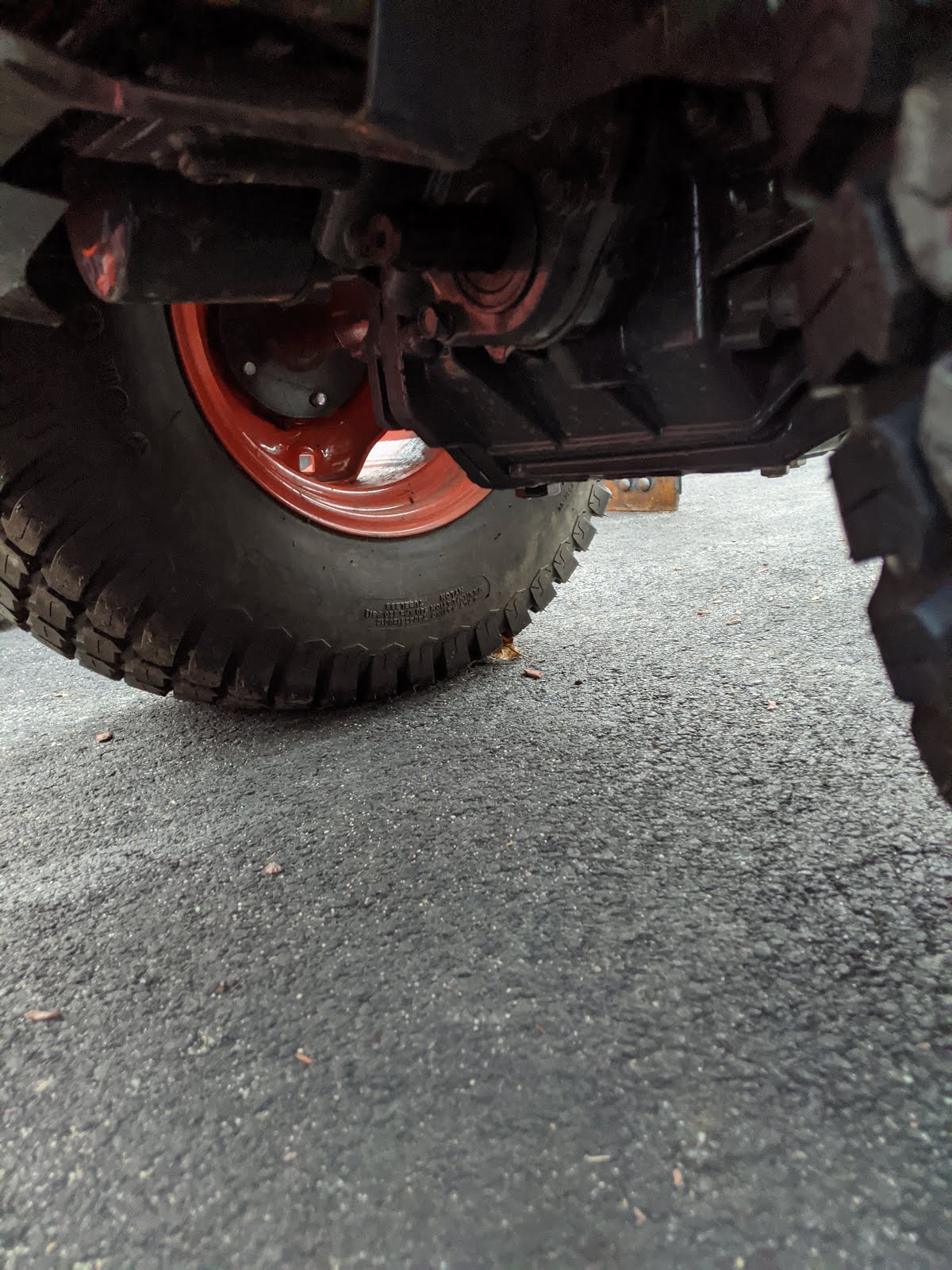
It isn't big enough to have the skid plates (I think Kubota only puts those on the B series and higher, not the BX models).  There is a little more ground clearance than the BX1880, but still pretty meh for tractors.


The underside is reasonably clean.


So it is decision time.  I think I would take this machine over a new BX1880, it is bigger, will hold its value better, and is cheaper.  The RK would be cheaper, I estimate around $11,500 when you include picking it up and getting the hydraulics installed (which isn't normally included in the cost of a new tractor).  I am assuming there are no taxes in KY, which I haven't verified yet.  There is also a chance I would need to get the tires re-filled with something more cold resistant.  Currently I am leaning towards the Kubota.  If I lived near a RK, it would be a no brainer, but the whole two weekends per single repair really stinks.

UPDATE - they sold this one yesterday, it was actually already sold when I went to look at it, I was too slow.  At this point, it is back to the BX1880 vs the RK.  I am still leaning towards the Kubota, but this was unfortunate.